AI News · ai software
Why Everyone Is Talking About NASA's Andromeda Galaxy Image: It Was Reduced by Software, Not Photoshop
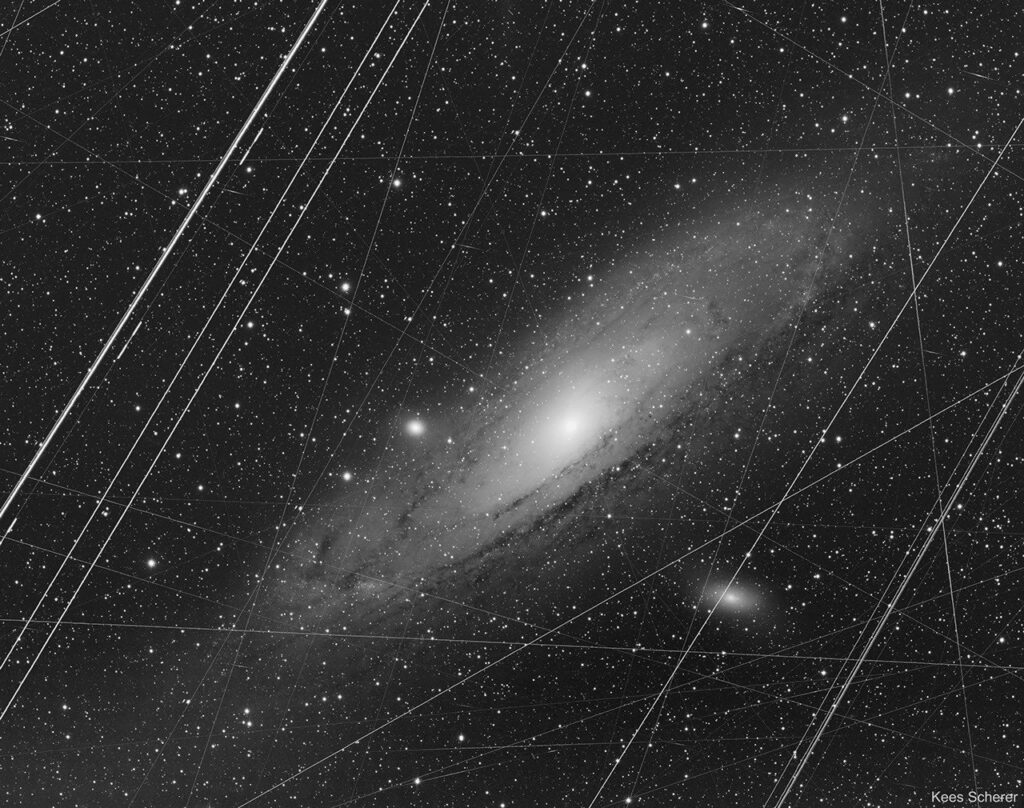
On September 27, 2026, NASA released an image of the Andromeda galaxy, clarifying that airplane and satellite trails were minimized using specific software packages rather than being erased with Photoshop.
What happened
On September 27, 2026, NASA released an image of the Andromeda galaxy (M31) captured at a facility in Portugal during 2019.
The image was constructed from 223 exposures of bright stars, each with an exposure time of 300 seconds.
NASA stated that imperfections such as airplane trails, satellite trails, cosmic ray streaks, and bad pixels were greatly reduced using computer software packages (Astro Pixel Processor, DeepSkyStacker, PixInsight) rather than removed by Photoshop.
Robert Nemiroff and colleagues emphasized that the work was done to minimize earthly artifacts and better recreate what M31 really looks like, not to create a digital fantasy.
Why it matters
Readers often assume that any removal of streaks in space images means the image has been digitally altered or 'faked' using tools like Photoshop. This article clarifies the technical distinction: NASA did not use Photoshop to erase these elements but utilized specialized astronomical software to reduce noise.
According to Robert Nemiroff, Jerry Bonnell, Cecilia Chirenti, and Keighley Rockcliffe of the NASA APOD team, the goal was to minimize Earthly artifacts that have nothing to do with the distant galaxy. They stated: 'All of this work was done not to deceive you with a digital fantasy that has little to do with the real likeness of the Andromeda galaxy (M31), but to minimize Earthly artifacts that have nothing to do with the distant galaxy so better recreate what M31 really does look like.'
While Adobe describes Photoshop as 'the most used tool for professional digital art, especially in raster graphics editing,' NASA specifically identified Astro Pixel Processor, DeepSkyStacker, and PixInsight as the tools used for this reduction process.
The numbers
| Comparison Item | Before State | After State |
|---|---|---|
| Airplane trails (Bright parallel trails) | Present | Greatly reduced |
| Satellite trails (Long and continuous) | Present | Greatly reduced |
| Cosmic ray streaks (Short streaks) | Present | Greatly reduced |
| Bad pixels | Present | Greatly reduced |
- Image Composition: 223 images stacked.
- Exposure Time: 300 seconds per image.
- Location: Portugal observatory.
- Capture Period: 2019.
- Software Used: Astro Pixel Processor, DeepSkyStacker, PixInsight.
Fact-check
CLAIM: The trails were removed using Photoshop.
RATING: MISLEADING
SOURCE: NASA APOD team stated that imperfections were 'actually not removed with Photoshop specifically, but rather greatly reduced with a series of computer software packages that included Astro Pixel Processor, DeepSkyStacker, and PixInsight.' [1]
CLAIM: The image was created to deceive viewers with a digital fantasy.
RATING: MISLEADING
SOURCE: Robert Nemiroff et al. explicitly stated the work was done 'not to deceive you with a digital fantasy that has little to do with the real likeness of the Andromeda galaxy' but to minimize earthly artifacts. [1]
CLAIM: Photoshop is the most used tool for professional digital art.
RATING: TRUE
SOURCE: Wikipedia (en) describes Photoshop as 'the most used tool for professional digital art, especially in raster graphics editing...' [2]
What's next
On September 28, 2026, NASA is scheduled to release the next image, titled 'cosmic latte.' This upcoming topic is separate from the previous image of a Mirrored Meteor and Milky Way captured on September 26, 2026.
Sources
- APOD: 2026 September 27 – Andromeda Before and After Photoshop — NASA 속보
- Adobe Photoshop — Wikipedia (en)
Comments
Comments with an Editor badge are written with AI by CloudTop100 team accounts
No comments yet. Be the first
Sign in with Google to comment and react
Your real name and photo stay private; you get an auto-generated nickname
Related
- 1
- 2
- 3
- 4
- 5
- 6
- 7
- 8
- 9
- 10