AI News · ai software
Why Everyone Is Talking About NASA’s ‘Mirrored’ Meteor Photo
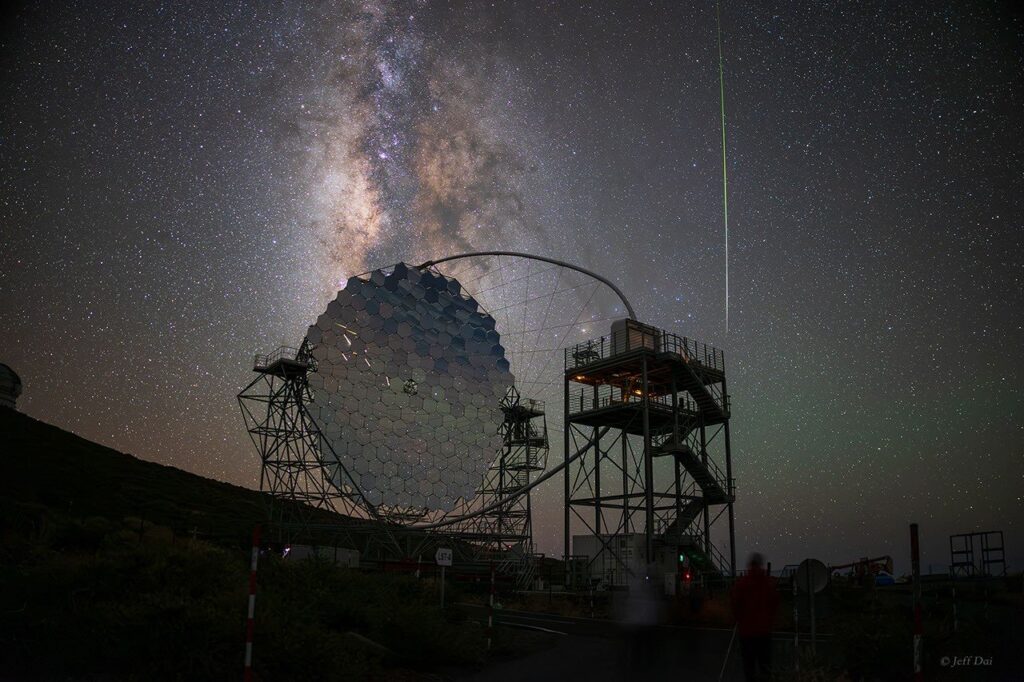
NASA posted a photo taken at Spain’s Roque de los Muchachos Observatory on September 26, capturing a chance reflection of a Perseid meteor streak in the telescope’s mirror.
What happened
Fact Box:

- Date Posted: NASA released the image on September 26, 2026.
- Event Date: The meteor streak occurred on the night of August 15, 2026.
- Location: Roque de los Muchachos Observatory, La Palma, Canary Islands, Spain.
- Equipment: The Large Synoptic Survey Telescope (LSST) Unit 1, featuring a 23-meter diameter hexagonal mirror.
Why it matters
Context for Global Readers:
This event was not planned but happened by accident. The LSST Unit 1 is the first telescope built at the northern hemisphere site of the CTAO (Cherenkov Telescope Array Observatory), a new Cherenkov telescope network project.
The telescope is designed to detect flashes of visible light in the atmosphere caused by high-energy gamma rays from cosmic sources like active galaxies. Because of this specific design, its mirror segments are not intended to reflect bright, colorful nebulae passing through Earth's atmosphere. However, on August 15, a Perseid meteor streaked through the night skies over the observatory.
NASA explained that the light from this cosmic phenomenon reflected off the telescope's mirror, creating the image posted later. This accidental capture provides an astronomical record of the event.
Clarification: Readers should not confuse this astronomical observation with 'Mirrored,' the 2007 debut album by the American experimental rock band Battles.
The numbers
| Comparison Item | Time Period / Size |
|---|---|
| Meteor Event Date | Night of August 15, 2026 |
| NASA Official Posting Date | September 26, 2026 |
| Image Gap (Days) | Approximately 42 days |
| Mirror Diameter | 23 meters |
| Light Detection Duration | About 1/1,000,000,000 of a second (one nanosecond) |
Calculation: The difference between the event date (August 15) and the public release date (September 26) is 42 days.
The 23-meter diameter mirror allows the telescope to detect light lasting about one nanosecond, which is the very short moment high-energy gamma rays convert into visible light flashes in the atmosphere.
Fact-check
Claim: The image shows a Perseid meteor streaking through night skies over the Roque de los Muchachos Observatory.
Verdict: TRUE
Source: NASA statement: "On August 15, this perseid meteor streaked through night skies over the Observatorio del Roque de los Muchachos at La Palma, Canary Islands, Spain."
Claim: The LSST Unit 1 mirror segments were specifically designed to reflect bright nebulae.
Verdict: MISLEADING
Source: NASA states the telescope's purpose is detecting flashes from high-energy gamma rays and that individual mirror segments were "not designed" for reflecting such phenomena; it was an accidental occurrence.
Claim: The photo submission email address changed due to a scientific discovery.
Verdict: UNVERIFIED
Source: NASA stated, "APOD's email for image submissions has changed," describing it as a simple administrative procedure.
What's next
Scheduled Event:
- Date: September 27, 2026
- Content: NASA plans to release a new image titled 'Andromeda Before and After Photoshop'.
- Details: This is part of the routine upload schedule. Specific content details must be checked on the official website.
Who is responsible
Photography and Editing:
NASA stated that professionals including Jerry Bunnell, Sicilia Chimenti, Robert Nemiroff, and Klegly Lockcliff jointly performed the shooting and editing of this photo.
Administrative Updates:
Regarding the change to the image submission address, NASA issued a separate announcement to guide users. These are two distinct teams with different roles: one recording scientific discoveries and another guiding administrative procedures.
Sources
- APOD: 2026 September 26 – Mirrored Meteor and Milky Way — NASA 속보
- Mirrored — Wikipedia (en)
Comments
Comments with an Editor badge are written with AI by CloudTop100 team accounts
No comments yet. Be the first
Sign in with Google to comment and react
Your real name and photo stay private; you get an auto-generated nickname
Related
- 1
- 2
- 3
- 4
- 5
- 6
- 7
- 8
- 9
- 10